Leaving 2019 Without Looking Back
I never had a habit of writing year-end reflections. To me, the transition from 12/31 to 1/1 is nothing more than Earth completing another orbit around an ordinary star on a spiral arm of the Milky Way. But 2019 did bring some real gains, so here they are.
2019 Was a Continuation of 2018

After graduating in 2017, I went straight to work. The whole experience was basically me sliding into adulthood — constant discomfort. In the second half of that year, living alone in Beijing, I was a mess, perpetually defeated.
By 2018, I started to stabilize. I gradually assembled a framework for how I see the world and settled on a direction for my career. I found my rhythm. Specifically, a few key ideas:
- The Tower of Babel: I realized Babel is a profound metaphor. What prevents humanity from building a tower to the heavens isn’t the fracturing of language — it’s the isolation between minds. Everyone is alone, and the only ultimate remedy for that loneliness is creation. Through creating, you transcend space and time, resonate with countless others, ripple into distant horizons. You are no longer alone.
- Existentialism: Late one night, I read and reread Sartre’s Existentialism Is a Humanism. I became an existentialist from that point forward. Existence precedes essence. Morality and the soul emerge through creation. A person is the sum of their actions. Once I thought this through, the malaise never came back.
- The XYZ Framework: This is a concept I invented to describe the three essential dimensions of getting things done. The Y-axis is vertical expertise — an engineer’s coding ability, a researcher’s analytical skill. The X-axis is horizontal mobilization — rallying people, capital, and resources, or more plainly, management. The Z-axis is the ability to navigate cycles — knowing what to do and when, a CEO’s competence. With this coordinate system, I started training myself deliberately along all three axes.
The growth I experienced in 2019 was an extension of 2018’s foundations. I had more hands-on experience, my theories were tested, and they evolved into something more grounded and practical.
- Consumption vs. Creation: I started consciously distinguishing between “consuming” and “creating” in both life and work. Buying designer bags is consumption; buying an SDK to build a product is creation. Scrolling short videos is consumption; writing an article is creation. Once you view everything through this lens, many things become entirely irrelevant, while others become immensely important.
- Creative Professional: This phrase had long been my LinkedIn tagline, but the experiences of 2019 deepened my conviction. Only creation can dissolve loneliness, and what a product manager creates can be infinitely amplified by the internet — there is nothing more beautiful than that. I also came to see that product management is essentially a transitional role. Ultimately, you either become a professional manager, or a CEO.
- Optimistic Nihilism: I used to love a line by Leonard Cohen: “A pessimist is somebody who is always worried it’s going to rain, and I’m already soaking wet.” But after being schooled by reality again and again, I kept growing more optimistic instead — because optimism at least preserves the possibility of something, while pessimism only guarantees standing still. The universe has no inherent meaning. Meaning is created. So create with optimism. That’s optimistic nihilism.
- I Can Do That Too: In 2019, I accomplished many things I never imagined possible — not because I lacked imagination, but because I’d assumed those things were far beyond my reach. Turns out they weren’t that hard. Going into 2020, I have stronger confidence and energy to push my boundaries.
- Freedom: One day it struck me that I don’t actually have many material desires. What I do have is a long list of things I want to do and no time to do them. I realized that for me, I don’t even need so-called “financial freedom.” I just need a stable cash flow. What I really need is complete freedom — the freedom to do something the moment I decide to do it.
Personal Infrastructure
One thing I focused on this year was personal infrastructure.
This was inspired by Stephen Wolfram. Wolfram is extraordinary — some call him one of the smartest living people. He won the MacArthur Fellowship at 21 and later founded Wolfram Research. After reading his article about his personal infrastructure, I was deeply impressed. He documents, digitizes, and analyzes his personal life and work in extraordinary detail, which is how he maintains formidable energy and creativity well into his sixties.
I’m nowhere near his level of rigor, but I’ve been managing a few areas:
- Bypassing the firewall: I spent some time studying network protocols and configuring things, and after that, the Great Firewall essentially ceased to exist for me. This access opened me to information of far higher quality than what’s available within the walled Chinese internet. I abandoned domestic apps in favor of products built by genuinely world-class companies.
- Information diet: Beyond books, I carefully curated my daily information intake — primarily RSS feeds, supplemented by a small amount of social media. This way I never miss a single post from people I admire, and I also encounter content I wouldn’t normally come across. I’m a firm believer: you are what you eat.
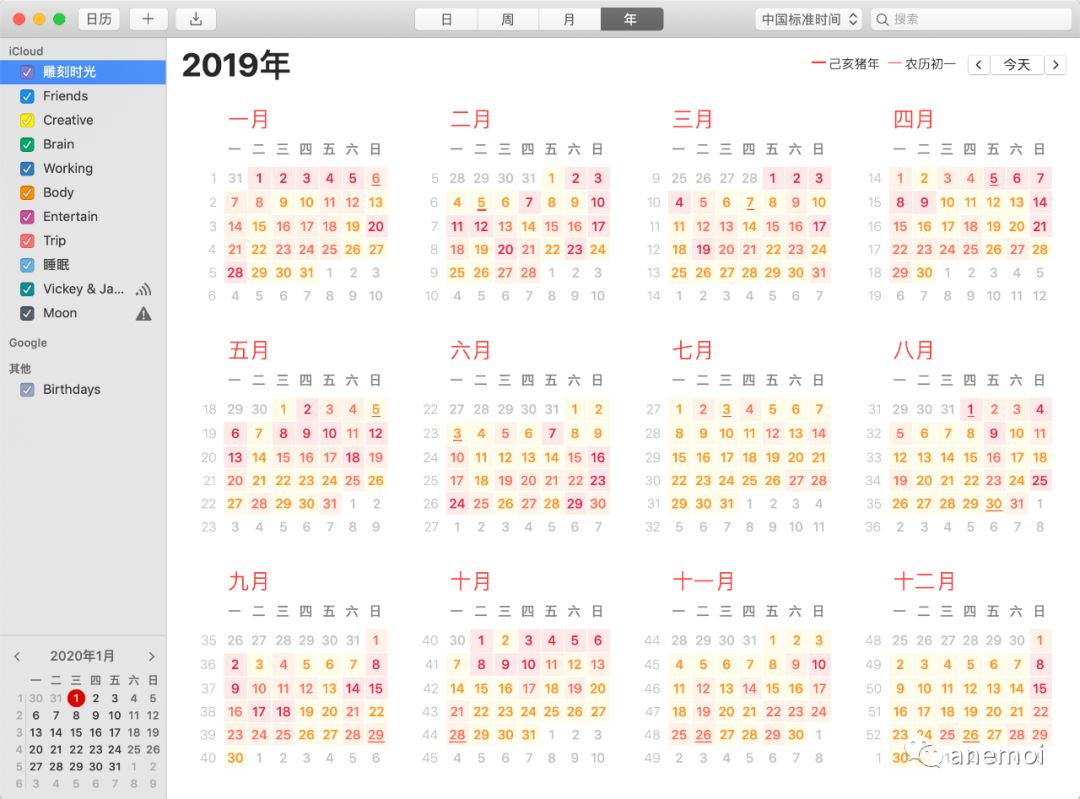
- Calendar: Since 2016, I’ve been using my calendar as a daily log, almost like a diary. For the past four years, every significant event has been recorded. This year I redesigned my recording rules to make the system more powerful and satisfying to use. A side effect: friends stand me up regularly, but because I log my schedule, I almost never stand anyone up.
- Task management: In 2019, on a friend’s recommendation, I switched from Todoist to TickTick. With TickTick’s kanban feature, my task management evolved from a line to a plane. I don’t believe in dogmatic methodologies like GTD, but the shaping power of tools on their user is real. When I can arrange tasks in a way that’s visually satisfying, it’s much easier to power through the work in one go.
- Life management: I started using Notion to manage all aspects of my life and build a personal wiki. In December, I also began experimenting with quarterly OKRs (2019/12–2020/02). Once I wrote down my OKRs, life gained a backbone. Even fragmented time could be effectively mobilized (the X-axis in action).
On Work
In 2019, I changed jobs once — leaving Shimo Docs to join a startup. I was employee number four and the sole product manager.
Shimo is a company with taste (and coming from me, that’s high praise — taste is nearly impossible to teach). My time there was genuinely interesting, and the people were excellent. But as the external environment shifted, the company’s trajectory and my personal goals diverged. When I first joined, everyone was fired up to build something ambitious. Then various factors forced us to pull back, and later we watched DingTalk and Yuque implement ideas we’d once envisioned. That still stings a little. I wish Shimo well.
But the experience made me start thinking about what business really means. Product managers love talking about user experience. In my view, the best user experience is serving the user while also making money — because a team that can’t sustain itself cannot deliver great experiences over time. What you should pursue is long-term global optimization.
Shortly after the new company was founded, we flew to Delhi and spent a month there — though we barely did any sightseeing. It was all heads-down development and street-level research. India was incredibly vibrant. My judgment: in the foreseeable future, the world belongs to China and India, and India may even outcompete China. Two reasons: 1) Indians speak English; 2) India has no firewall. Together, these mean Indians have access to information of far higher quality. What struck me most was this: when an Indian wants to learn something — say, “how to do ASO” — they go straight to YouTube, where the world’s best content is available as online tutorials. The efficiency is incomparable. In China, your options are Baidu? Toutiao Search? Don’t make me laugh.
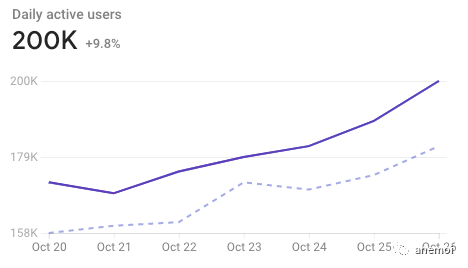
Our team spent some early time deploying infrastructure and getting in sync, then shipped the first product. It didn’t hit targets, but we discovered a viable path. The second product got pulled from the store right after launch due to some issues. After fixing them and re-listing, it grew rapidly. We kept polishing the product with weekly releases, and retention climbed fast. We peaked at #18 in the India category on Google Play, with 200k DAU and 55% next-day retention. Compared to competitors, those numbers were strong.
We’d originally planned to focus purely on user experience, but the market shifted faster than expected, and we pivoted in time. I won’t say much about the current project — making money quietly is the best approach.
Someone once asked on Jike: do young people today think ByteDance is a cool company? My answer: Yes, way cooler than BAT, roughly on par with Facebook, but nowhere near Tesla or NASA. An absurdly powerful recommendation system — isn’t that cool? A monetization engine that prints money from traffic — isn’t that cool? A low-rise office in a converted airplane museum — isn’t that cool? Though admittedly, it’s still a step below spaceships.
Breaking my offer with Huawei to join ByteDance in 2017 was one of the best decisions I’ve ever made. Without any false modesty, I’d already foreseen that ByteDance would grow into the new BAT. I learned an enormous amount there, even though much of it only clicked in hindsight. Now I’m more convinced than ever that business is a great endeavor, and profitability is the highest moral standard in commerce.
On Life
In 2019, I still didn’t have a cat.

But this year I met many new friends, and became very close with quite a few of them. The chemistry between people is a mysterious thing — with some, you know from the first meeting that something is different. I also reconnected with some old friends. I can be stubborn, and I’ve had arguments even with friends I care about. We made up. I’m grateful for their patience.
In the new year, I hope to meet even more people. I still prefer meeting in person — anyone reading this, let’s grab a meal, coffee, drinks, or whatever.
In October, I went to Australia. My friend Ao and I went skydiving and saw the Great Barrier Reef. Sadly, I didn’t get to hold a koala. Later, Australia suffered devastating bushfires and many koalas perished. I hope people will pay attention to them as well.
One noon in November, while chatting with a friend, an idea about the future world came to me. With that friend’s help, it was turned into a script, illustrated as a comic, and published on GQ’s official account. Thank you, friend. One evening in November, after a few drinks, I wrote a science fiction short story in one sitting. I shared it with a few friends and the feedback seemed quite positive — a new chapter, perhaps. The imagination is still there. I’m still young.
After snow season began in December, I went snowboarding every Sunday, settling into a rhythm of working Monday through Saturday and riding on Sunday. I got hooked on snowboarding from my very first time the year before. This year I practiced deliberately, following tutorials from pros on YouTube, and the progress was gratifying. Once I can handle the advanced runs freely, I’ll consider myself ready to leave Beijing. Snowboarding suits me perfectly. It’s just the slope and myself. I must be fully present in body and mind, or I’ll fall. I must keep moving because stopping means freezing. The moment I go flying through the air is the most liberating instant of the week, and surrendering to gravity and landing squarely on the ground is the most real. (Kids, don’t try this at home.) Learning to snowboard also gave me a lot of confidence. I’d always thought of myself as hopelessly uncoordinated, but now I believe that “uncoordination” was just the result of being told too many times as a kid that I couldn’t. With the right method, I taught myself a sport from scratch. What’s uncoordinated about that?
That’s about it for 2019.
Here’s to a badass 2020!
Don’t wish me smooth sailing. Wish me wind and waves.
2020-01-01 @ Beijing