What We Talk About When We Talk About Snowboarding
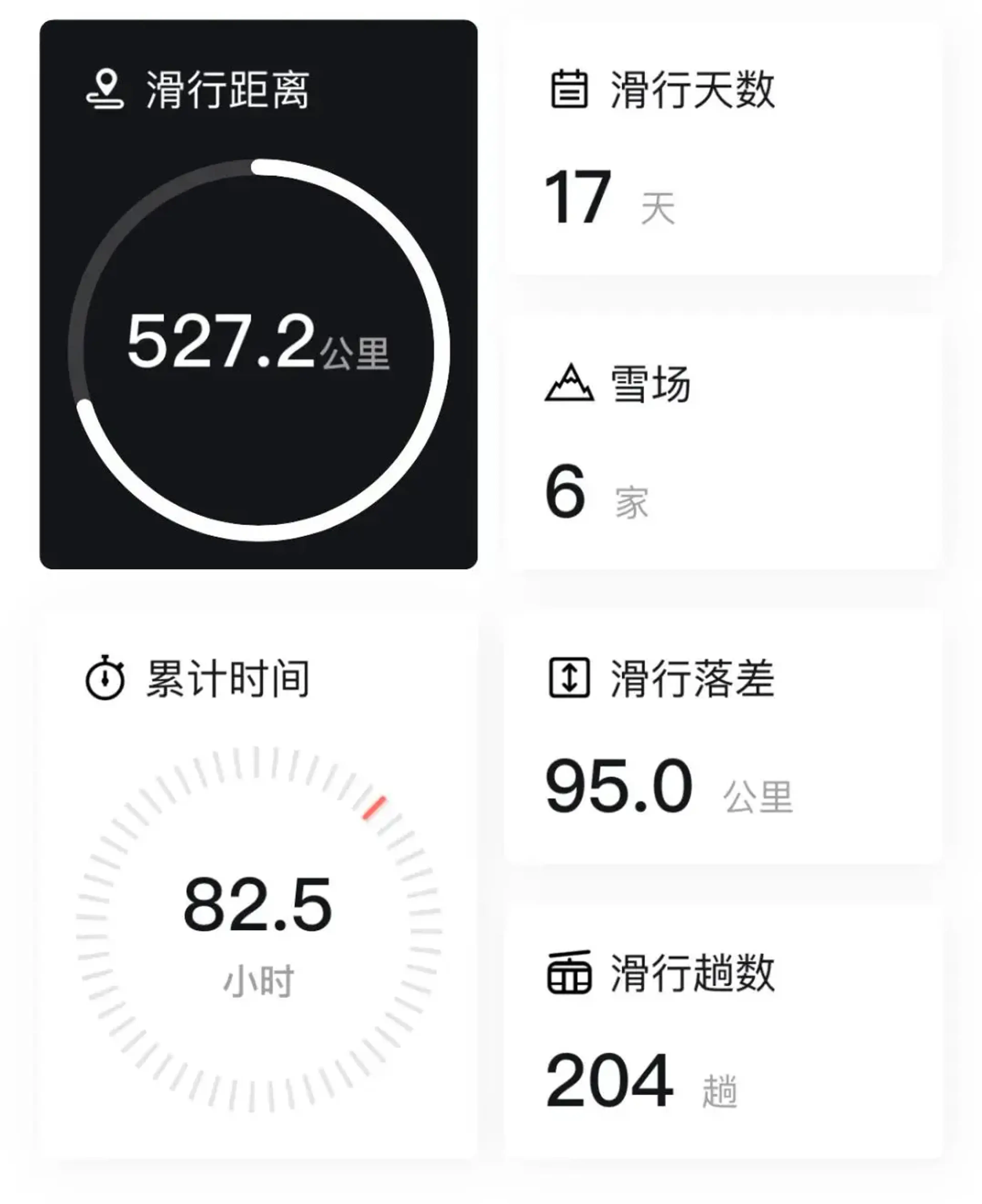
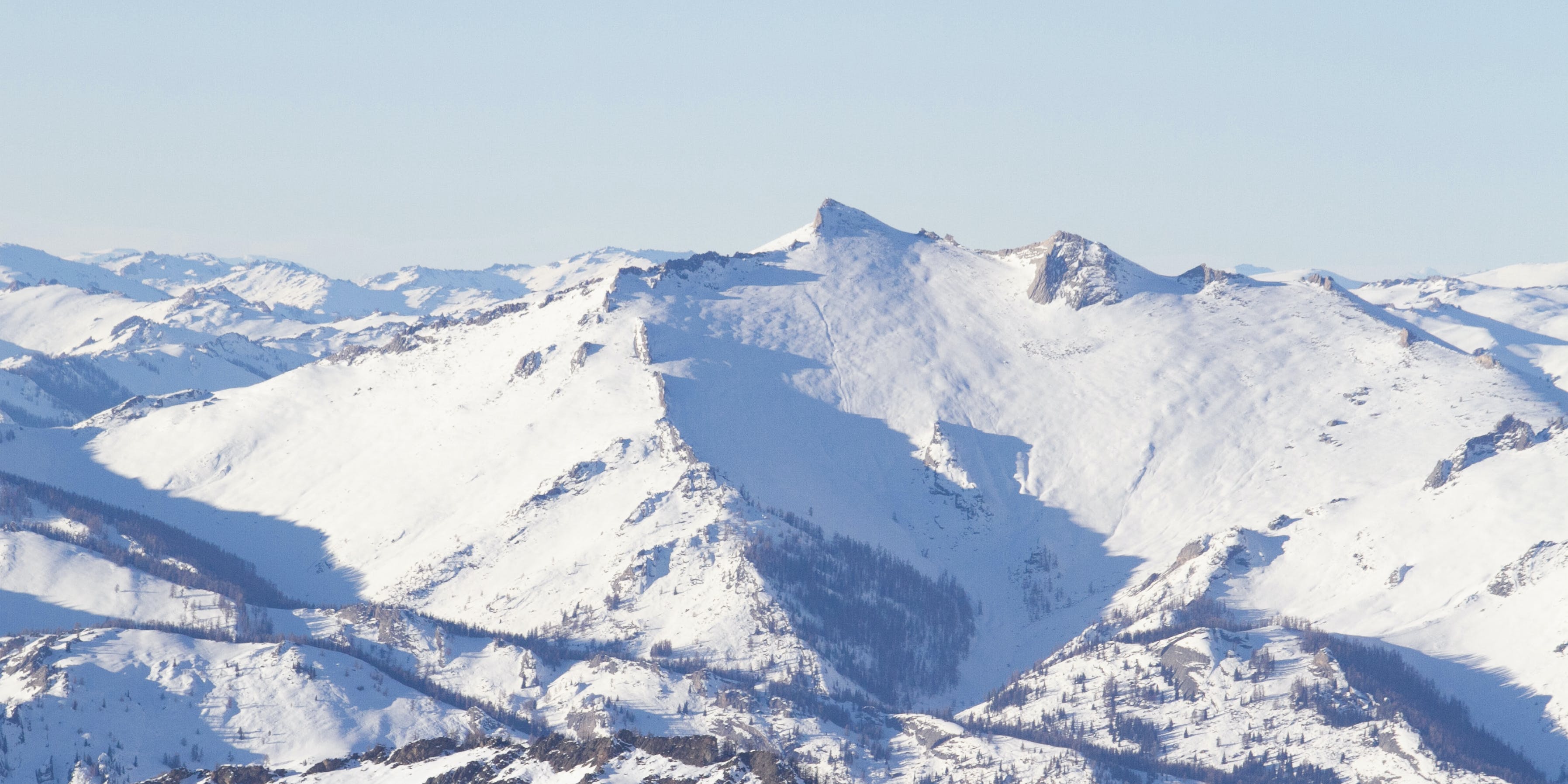 Over New Year’s I went to Keketuohai. I rode 200km on-piste, and tried off-piste runs through glades and backcountry powder. My season mileage crossed 500km. With the trip behind me and Chongli locked down, the 21/22 season was probably over.
This is my second real season of snowboarding. It brought me plenty of joy, pain, unforgettable experiences, and wonderful riding companions. This piece is my attempt to record what my friends and I have gained and learned from snowboarding.
Pain and Joy, Inseparable
I’d gone to suburban Beijing resorts a few times in the winter of 2019, but those were just messing around. In the winter of 2020 I bought my own boots, followed Huang Jialan’s tutorials on YouTube, and properly began learning the sport.
The slogan these days is “300 million people on ice and snow,” and Xiaohongshu is full of influencers posing in bikinis at ski resorts. But snowboarding is, first and foremost, a genuinely dangerous sport.
Amnesia
On December 12, 2020, my first time at Thaiwoo, I fell on the Salsa run and lost my memory. My helmet cracked open. When I came to, I was lying on the slope with no idea why I was there. Before waking I’d dreamed profusely — fragments from recent months: racing through a ginkgo grove in warm sunlight; the wind off the coast in Quanzhou; the scent of osmanthus on a Shanghai sidewalk, my last visit; a little boat in Beihai Park… I had to check the calendar on my phone to figure out who I was and where I was. I sat in the lodge at the base for over half an hour before my memory finally came back. I still don’t know how I fell.
Later, in a skiing group chat, I discovered that four other guys had also been injured that same day. Given that the group had fewer than two hundred people, that ratio was terrifying. We made a pact: December 12th — no skiing. I set up a recurring annual reminder to stay away from the mountain that day. (I even seriously looked into the lunar phase and astrology for that date. Nothing turned up.) But on December 12, 2021, I couldn’t resist. I had a great half-day at Genting and made it back to Beijing in one piece. A curse broken, I suppose.
Got a new helmet afterward to save my life. This is roughly what it looks like on.
The Quattro Blowout
This season, pandemic restrictions and Winter Olympics prep made Chongli’s access policies shift daily. One November weekend, @SAAB and I planned to go to Genting. The night before, some riders got through while others were turned back. Saturday at dawn we decided to send it anyway, grabbed a Q5, and set off before first light. Riders ahead reported safe passage. At 9:50 we reached the Taizicheng toll station — disaster. The inspector told us that at 9:35, fifteen minutes before we arrived, they’d received a call from leadership: all vehicles from Beijing, turn around. Fifteen minutes. Goddammit.
But we refused to accept it. We found a back road, thinking we could get around the checkpoint. The road kept getting smaller. First we passed through a village that appeared to have never seen outsiders — a woman sat by the road cracking sunflower seeds, looking at us like we were idiots. We kept going and arrived at the foot of a mountain blanketed in untouched snow, not a single tire track. No worries — we had Quattro (Audi’s all-wheel drive). The snow was very deep, the road narrow, a cliff right beside us. But we had Quattro! @SAAB drove with fury and finesse, crawling up the snowy slope like a gecko — and then disaster struck again. Quattro was stuck in a ditch.
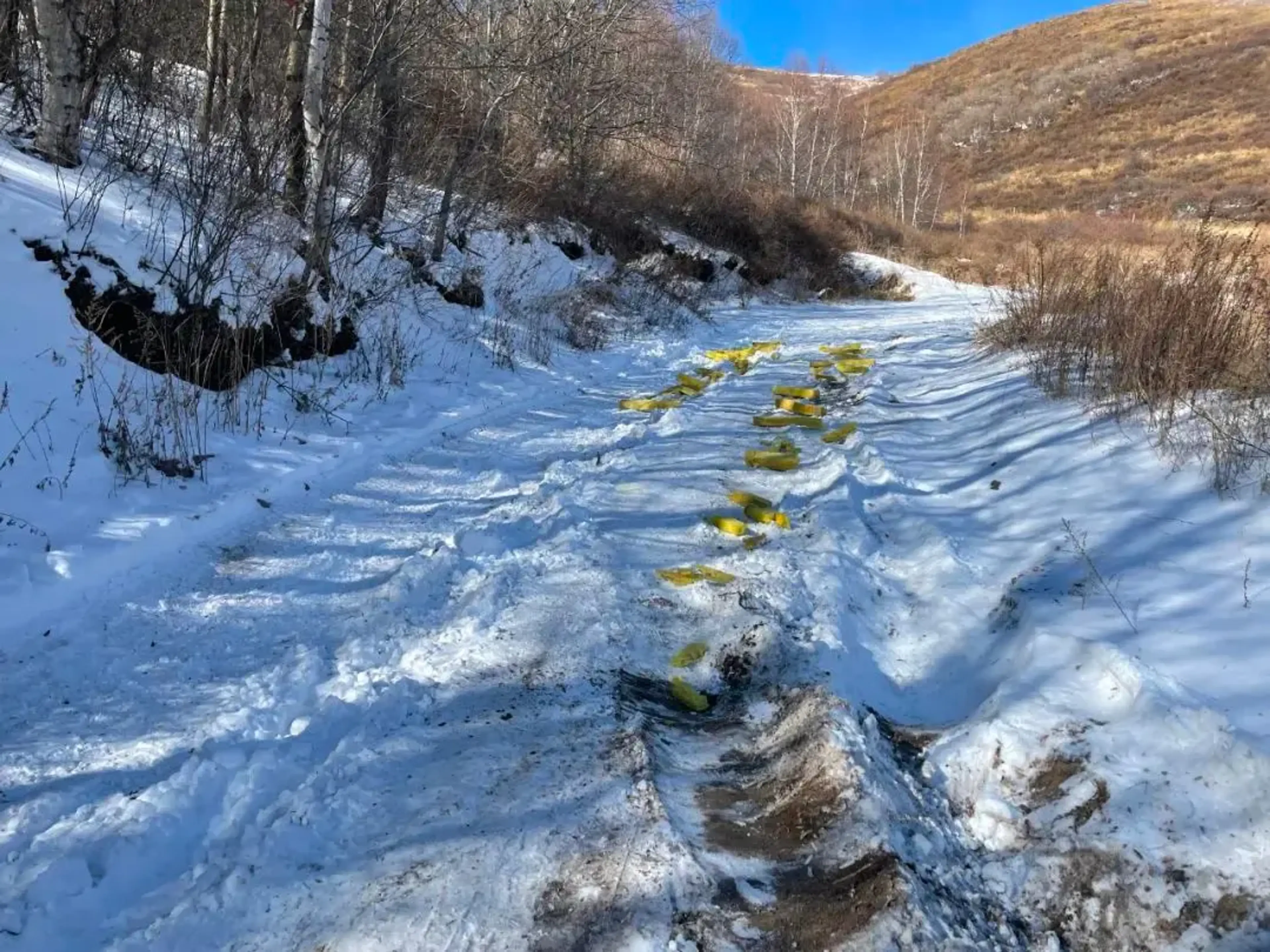
No road? Make your own.
We shoveled snow, laid down tree branches and some ratty foam strips someone had left there, and finally freed the Quattro. We gunned it up to a plateau — now just a short stretch to the summit, and over the top was Thaiwoo’s peak. Then we discovered: disaster, once more. Left rear tire, blown. Probably torn up while thrashing around in the ditch. Stay calm — we had a spare. So we wrestled the spare on, only to find: yet another disaster. The Q5’s spare was a compact tire, and there was no air pump in the car. We put the flat back on and limped back the way we came. The woman was still by the road cracking sunflower seeds. This time, she was definitely looking at us like idiots.
In retrospect, every decision we made was optimal given the information we had at the time. But the universe was too cunning and our luck too rotten. At least we’re both optimists. The bathhouse in Zhangjiakou was nice.
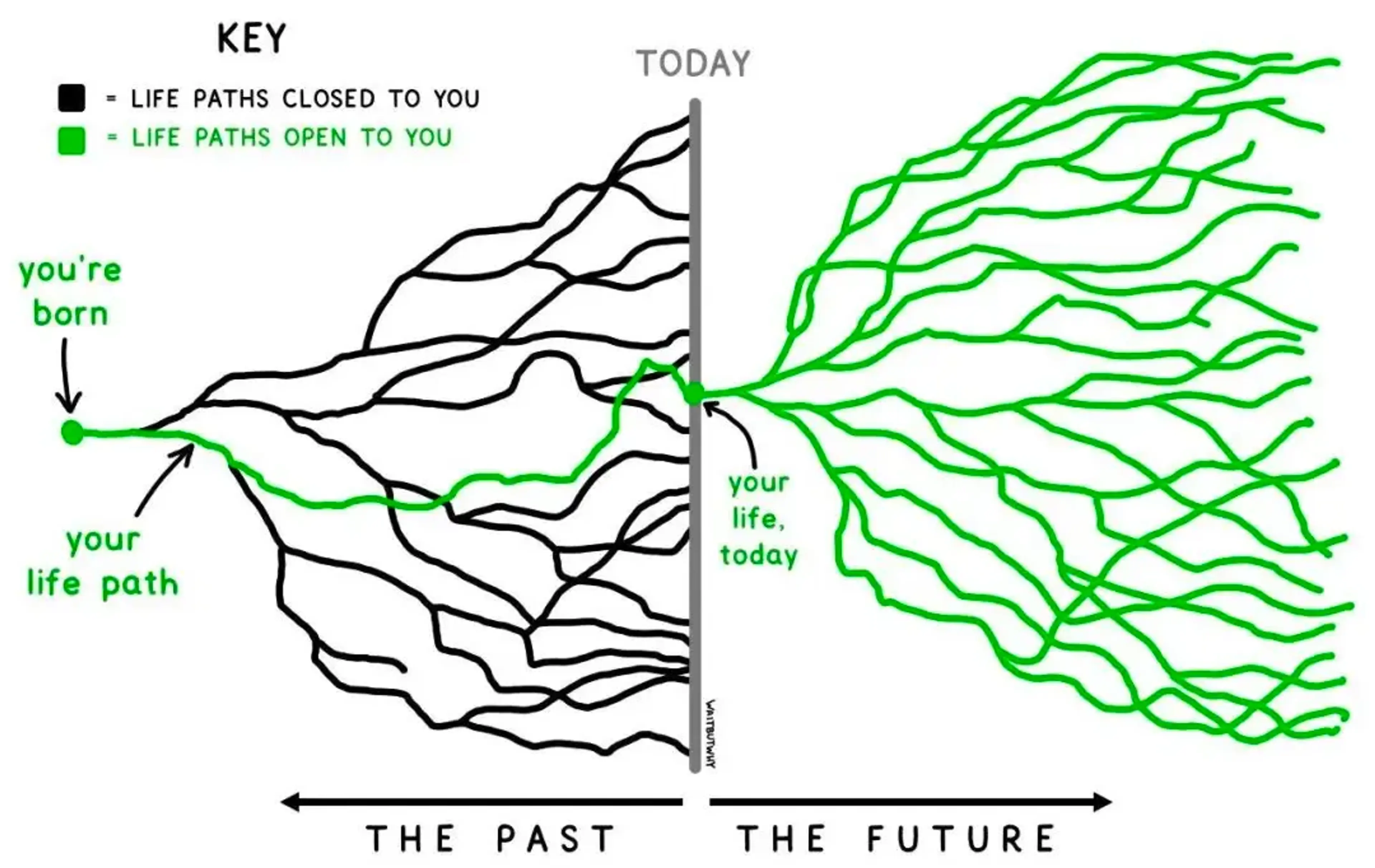
A greedy algorithm doesn’t necessarily lead to the global optimum.
Knowing Yourself and the World
Amnesia, countless bruises, a blown tire, exorbitant outlays of time and money… More than once I backed myself into a corner and asked: Why am I doing this to myself? Why seek out suffering? Why snowboard? Why the hell why?
In my 2019 year-end review, I wrote that snowboarding is a sport of being present with yourself: when you’re riding, “you must unite body and mind, or you fall.”
Back then I was a beginner (I still am), but two years later I still agree with that view. As my technique has improved and my understanding of the sport has deepened, though, I’ve arrived at something new.
Snowboarding is a process of knowing yourself. For the first time I learned exactly how many degrees my hip joints could rotate before locking up, learned that my flexibility was so poor I couldn’t even kneel properly. I kept learning more about myself — my stamina limits, the amount of fuel and rest I needed as I approached those limits, which gradients I could ride and which I could only sideslip down. Only with this knowledge could I deliberately push those limits further.
Snowboarding is a process of deliberate practice. First you must overcome your fear of speed and falling, and gain control of your board. Then you must overcome your fear of steepness — those towering peaks that look so menacing from the base aren’t actually as terrifying as they seem. Then you must deliberately unlearn your instinctive movements, correct the wrong ones, even though they feel familiar. You must deliberately do the unfamiliar but correct thing in order to break through to the next level.
Snowboarding is a process of knowing the external world. You learn which boots, bindings, and protective gear suit you, and how to fine-tune them for maximum comfort. You come to know your board — its sidecut radius, exactly how far you can extend a turn before redirecting the force so it doesn’t wreck you from the inside. You learn the mountain — which spots have the best snow and fewest people, where the hidden bumps are, where you can open it up, when the snow has been chewed up enough that it’s time to call it a day. You also learn your friends — when exactly to drop a hint and get a crew together.
And so you know your own capabilities. You bring familiar gear, join your friends, and conquer run after run, peak after peak. God, how good that feels.
None of this comes easy. It demands enormous investments of energy and money, the constant breaking of instinct and path dependence, the building of new and correct muscle memory. But as Haruki Murakami — perennial Nobel bridesmaid — once said about running marathons: it is through pain that we know we exist.
Breaking Limits, Seeking Freedom
On a chairlift once, @Lion Bro and I got to talking about the arc of snowboarding:
At first we overcome fear, learn technique, build correct muscle memory and snow-sense — the constraint is skill itself. Once we’ve got the method down, fitness and core strength become the bottleneck. Solid stamina is what lets you clock at least 30km a day, accumulating hours and mileage. If your core isn’t braced through a carved turn, you can’t withstand the centrifugal force that comes with speed. When none of that is the problem anymore, the resorts around Beijing — even Chongli — probably won’t satisfy you. Northeastern China and Xinjiang beckon. Further out, Japan. Further still, Switzerland, Austria, Canada. In summer, New Zealand. Beyond groomed runs, there are tree runs, big-mountain powder, ski touring, even heli-skiing — something for everyone. Now the bottleneck is time and money. And by the time you can freely hop between the world’s great ski destinations every season, chances are you’re no longer young. The constraint, then, is the fight against time, aging, and injury.
The pattern is this: the further you progress, the more fundamental the capabilities you need — and fundamental capabilities are the hardest to build. When you’re young you can just send it. But to be snowboarding at forty, you need a strong body, a harmonious family, a supportive partner, a stable career, financial freedom, and a young mind…
Seen this way, “See you at the summit” is a beautiful blessing indeed — laden with so many unspoken hopes for a good life.
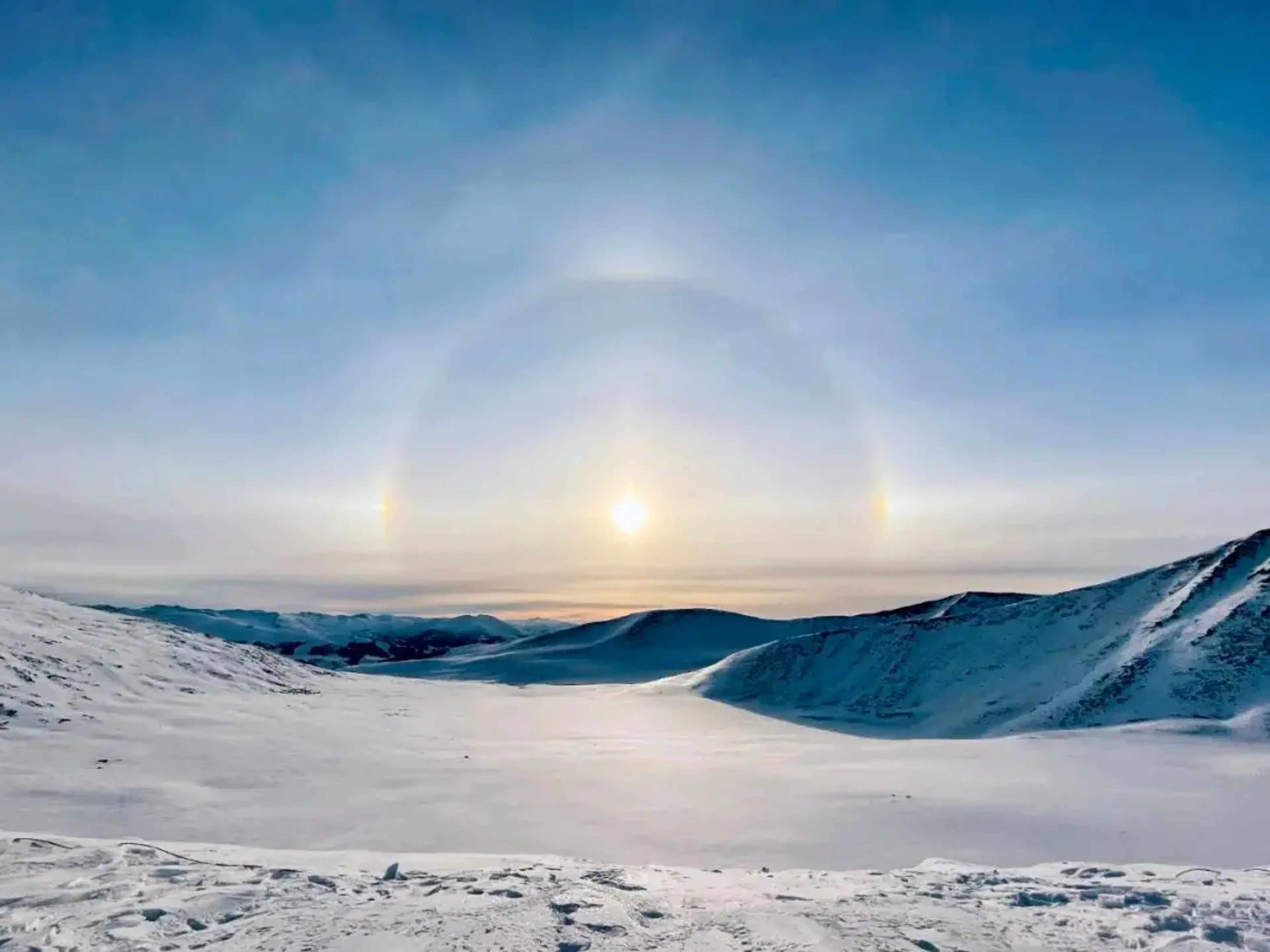
Sun dogs over Keketuohai. I nearly dropped to my knees in reverence.
We keep breaking through limits, gaining greater freedom, entering larger worlds, challenging higher peaks.
See you at the summit, friends!
The first draft was written on the flight back from Urumqi to Beijing, but I kept putting off publishing it. This past weekend I couldn’t resist — another trip, this time to Qishan. And then, disaster. My ankle was done. Turns out you shouldn’t tempt fate by writing “the 21/22 season was probably over.” Now it really is.
So here I sit on the second floor of the resort lodge, by a window. Outside it’s snowing hard. My friends are carving through fresh powder. I feel nothing at all — just that my ankle is a bit swollen.
2022-01-23 @Beijing