Planting Flowers on Quicksand
1
Everything has an expiration date.
A can of pineapple lasts 30 days. A bottle of Coca-Cola lasts 12 months, though once chilled it’ll be drained in 10 minutes. The lawn in the corner park lasts about 2 months before the weeds take over. Even “real estate” expires — a home renovation lasts seven or eight years at most, perhaps longer with careful upkeep, but no amount of maintenance can withstand the disinfectant of pandemic-prevention enthusiasts.
People have expiration dates too. In Beijing, it’s 72 hours. In Shanghai, somewhat shorter. In Shenzhen, just 24 hours. Your understanding is appreciated.
It’s quite fair, in a way. Whether you’re a top-university exam prodigy or the scion of a political dynasty, a refined egoist or a day-laborer drifter, your shelf life is exactly the same — determined solely by which cell towers your phone has connected to.
2
Mayday sings in one of their songs:
“Why does a life end up like a scrap of paper, when once it was as vivid as a petal?”
People fall far short of flowers. In May I visited a botanical garden. The roses were in staggering bloom. I couldn’t help myself — I transformed into one of those old amateur photographers, and began fantasizing about owning a garden in old age. Growing my own flowers. Rising with the sun, resting at dusk. Observing the shifts of solar terms and lunar phases. I would eat only “leaves picked by a virgin under moonlight,” and at sixty-four, die in my own garden while playing with my granddaughter.
“No regrets being born in China, in the next life I’ll be reborn in the land of flower-planting” — I suppose that’s the self-cultivation of a Chinese person like me.
Yet what many Chinese fail to grasp is this: when it comes to growing beautiful flowers, farming skill is merely a sufficient condition. Solid ground is the necessary one. When a plot of land gets rerouted today and sealed off tomorrow, when all you do is run from place to place without getting anything done — how exactly is “development” supposed to be the hard truth?
3
Those who have stable property will have stable hearts. Those without stable property will lack stable hearts. And without stable hearts, there is nothing they will not do.
— Mencius, Teng Wen Gong I
Chinese people like to view things dialectically, so naturally the concept of “stable property” is relative too. Consider: a house with a 70-year land-use right is called “immovable property.” Meanwhile, a deeply moving investigative report, a silent black-and-white video — things that leave indelible marks in countless minds — can’t survive half a day on the Chinese internet. Your praise, joy, anger, unease, and all 404 varieties of emotion and expression are swallowed by the abyss in no time, vanishing without a trace. When you gaze into the abyss, the abyss invites you for tea.
So what do we do? A certain Elder once shared his life wisdom: you must “run even faster than they do,” and “make your fortune in silence” — whatever you do, don’t “make a big story.” Ministry spokesperson Mr. Zhao offered similar advice: we should “rejoice in secret.” As the saying goes, “moisten things silently” — that’s the principle.
4
When you’ve been swallowed by the abyss enough times, you inevitably slide into nihilism.
Borges wrote a story called “The Circular Ruins”: a sorcerer exhausts himself creating a son out of dreams. He teaches his son everything and takes great care to prevent the boy from learning he was born of a dream. But in a great fire, when the flames consume him yet leave him unharmed, the sorcerer finally knows — “with relief, with humiliation, with terror — that he too was a mere appearance, dreamt by another.”
Perhaps the world really is as Borges described — fundamentally void. All of existence, nothing but froth and phantom. All pasts, presents, futures. Everyone you’ve loved, everyone who has loved you. Everyone you’ve despised, everyone who has despised you. All the nationalists and pink-hued patriots across parallel universes, all the public intellectuals and self-proclaimed centrists — all of them, one person’s dream. Whoever dreamed up a world like China must have quite the palate.
And so each of us is another’s phantom, and simultaneously we dream, producing new phantoms, on and on without end, generation after generation inexhaustible — in this moment, the Chinese people achieve the great cosmic harmony of life.
And so countless Chinese dreams radiate outward like ripples from each individual center, followed by talk of “differential order” and “cultivate self, regulate family, govern state, bring peace to all” and other such obscure formulations, provoking laughter even among the Trisolarans. The universe is filled with a cheerful atmosphere.
5
For some of us, the world truly felt like a dream: joining the WTO in 2001, the Olympic spectacle of 2008, individual travel to Taiwan… Back then we had dreams — about literature, about love, about journeys across the world. Now we drink late into the night, pull the blanket over our ears, but can’t muffle the loudspeaker calling us downstairs for another PCR test.
In the Tang dynasty, Lu Sheng woke from his dream and sighed, “Twenty years — nothing but a millet dream.” Is it now our turn to wake from a forty-year dream? The world we saw, the accomplishments we achieved — were they too nothing but a dream?
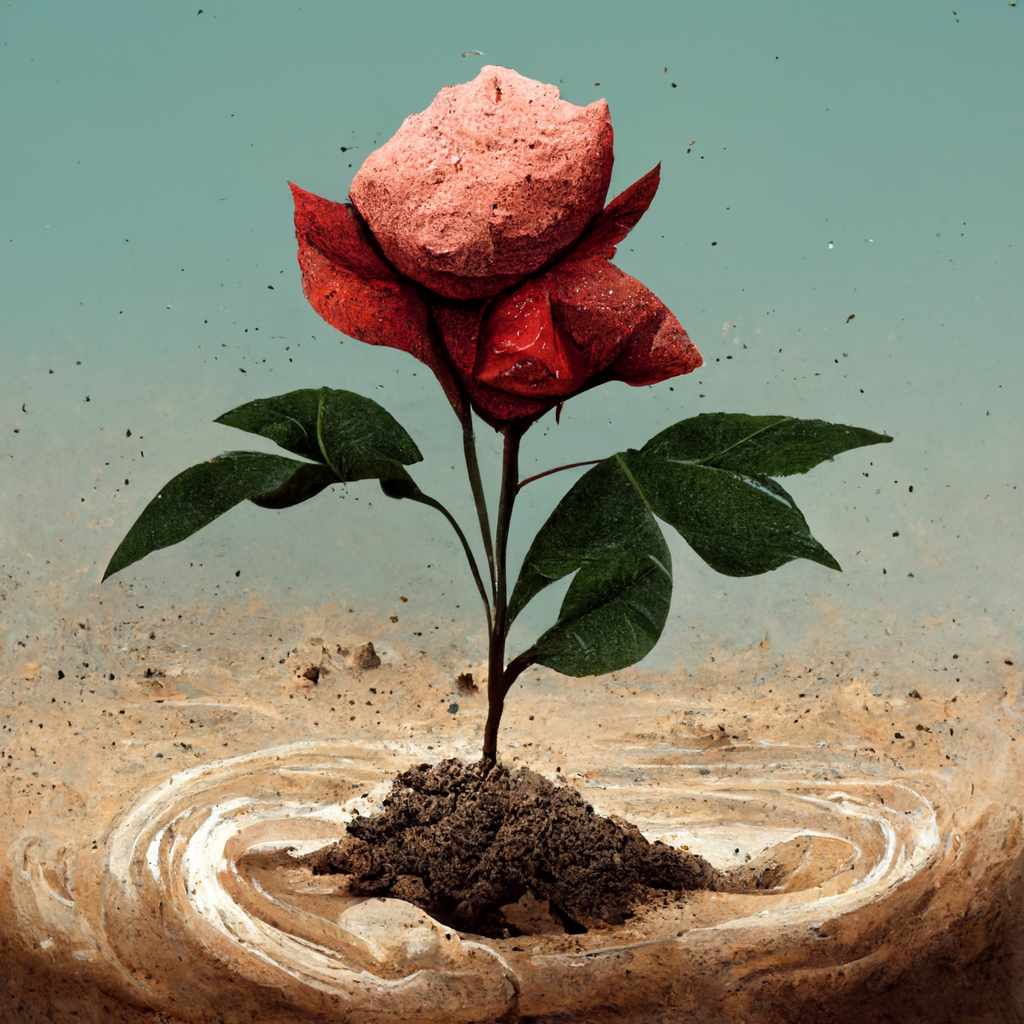
My friend Yang gave a one-line summary: planting flowers on quicksand.
When policies change by the hour, personal rights shift allegiance morning and evening, and relationships can’t survive a single season — how could anything last? Isn’t this exactly what it means to plant flowers on quicksand? In a given slice of time, the flowers can be beautiful. But what does it matter?
Heraclitus said: you cannot step into the same river twice. Everything is in flux. Everything will flow. Ha — all things flow, all of it flowers on quicksand. And just like that, we’ve slipped into nihilism again.
The universe is constituted by space and time. Time is a coordinate axis moving forward at a constant, irreversible pace. It waits for no one. Before time, everyone is perishable. I work 996 at my startup; he works fifty years for the motherland’s health. We both have bright futures. Years from now, we’ll sit together atop a high grain pile in the nursing home, telling our caregivers stories of the days before COVID.
COVID is in its third year now, and the time feels stolen. Perhaps after a few more swabs jammed down our throats, a lifetime will have passed — hence the saying, “Time flies like an arrow; days and nights are screened.” Akutagawa Ryunosuke said: life is not worth a single line of Baudelaire. I say: life amounts to no more than ten thousand cotton swabs. (30,000 days is roughly 82 years; one throat swab every 3 days.)
Life is this brief, this perishable. Life itself is quicksand. As for policies, personal rights, love… please — they’re all quicksand. Who’s looking down on whom?
6
Sorry to show you the truth. Let me walk it back.
Heraclitus also said: the fundamental substance of all things is fire. And fire leaves traces after it burns. However perishable we are, we can still leave something behind.
Articles get 404’d, but the ripples they’ve stirred keep spreading. Accounts get banned, but the influence they’ve generated remains. Bodies get quarantined, but the love they’ve created doesn’t go to waste.
Create. Create works to spread ideas. Create bonds to resist separation. Create love to kindle more love.
Be an existentialist. Have the courage to create the future you want. Never stop believing that the future you want can be brought into being.
The universe will collapse. Orion will become a black hole. Seas will dry and stones will crumble. Everything we’ve read, written, loved, and hated will dissolve in the wind. We will die. Our attempts will most likely fail, will most likely prove meaningless. Even the most beautiful flower has its season.
But that’s all right. Even though everything has an expiration date — if parting comes before the date runs out, then it counts as a good farewell.
And before the date runs out, we can create as much as we possibly can.
2022-10-15 @Beijing